


Understanding Saints and Archangels: History, Roles, and Paranormal Perspectives

For the month of October, we all prepare for Halloween, or “All Hallows’ Eve.” Then, on the Christian calendar, we jump right into “All Saints’ Day,” also known as “All Hallows’ Day,” Hallowmas, or the “Feast of All Saints.” This is the day that Christian churches commemorate all the saints of the Church. The celebration is on November 1st in Western churches and on the first Sunday after Pentecost in Eastern churches.
In honor of All Saints’ Day, I thought I would learn more about saints and pass what I have learned on to you. I was brought up Christian in a Protestant faith, but I wasn’t taught much about specific saints. Those teachings were often left to those who follow the Catholic faith.
As the co-founder of a paranormal team, we use prayers involving saints, and I understand that those who follow Catholic teachings often pray to or ask for assistance and guidance from saints.
I first wanted to know how many saints there are. In this modern age of technology, I did what anyone else would do — I Googled my question — and I was amazed at how many saints were recognized. There are at least 8,050 in total. This number includes all saints, blessed, and venerable (a title for someone proclaimed by the Roman Catholic Church to have attained the first degree of sanctity, or within Anglican tradition as an honorific title). So, I am not going to write about all 8,050 — this blog would turn into a book.
There are so many saints that, when prayed to or asked for guidance, it can be hard to choose. My head is spinning with the amount of knowledge one must know. Please don’t be offended if your favorite saint isn’t mentioned.
The Virgin Mary
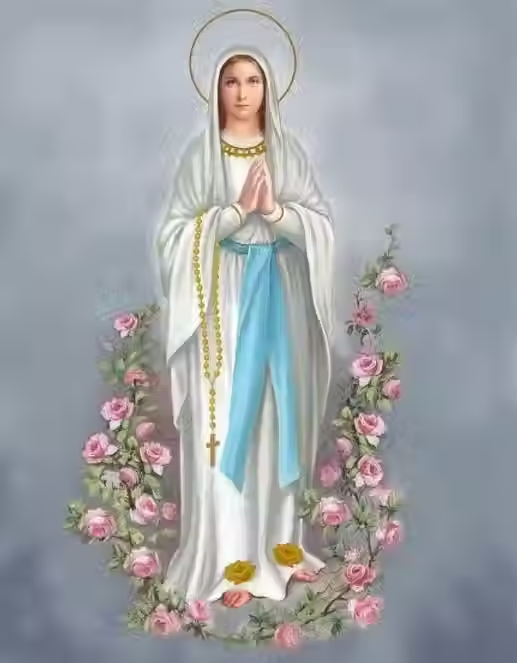
It is best to start off with probably the most important saint (in my opinion), Saint Mary — arguably the most important saint of all. Mary, the Virgin Mother of Jesus Christ, is said to have been born without the burden of sin. Like her son, she too has been exalted by divine grace and placed above all angels and men. It is said that when you ask Mary for guidance or help, she asks her son to perform the task you request, and that the task will be granted because Jesus will not deny his mother’s requests.

Saint Anthony: “Saint of the Lost”
Saint Anthony is a popular saint and is often known as the go-to saint of the lost. Saint Anthony isn’t just for lost items — he is sought out for all the lost: lost people, lost causes, and most importantly, lost souls. St. Anthony’s voice alone is said to have had the power to convert non-believers after hearing just one of his sermons.
Saint Vincent: “Saint of Charitable Causes”
Saint Vincent is called upon when charitable causes need help. Having experienced a life of poverty and struggle as a slave, Vincent shifted his focus toward the poor and destitute. Saint Vincent aimed to feed and clothe the poor and provide shelter for women and children. As he became more familiar with the needs of the people, he found financial backers who helped fund hospitals and gather relief for victims of war. It is said that he also helped free some 1,200 galley slaves from North Africa.

Saint Christopher
Saint Christopher, the patron saint of travelers and children, isn’t technically recognized as a saint in the formal historical sense — at least, there is no clear documentation of his beatification or canonization. His claim to fame is that he chose to guide travelers across a difficult river. Saint Christopher was a large and strong man, and other men who attempted this job often failed and drowned.

The legend goes that a child approached Saint Christopher and asked him for help crossing the river. Saint Christopher carried the child across, but midway through, the child became extremely heavy. It took all of Saint Christopher’s strength to carry him, but they made it to the other side.
When Saint Christopher asked the child why he became so heavy, the child responded that he was the Christ child — and that when Christopher carried him, he was carrying the weight of the world. From this legend comes Saint Christopher’s association as the patron saint of children as well.
These are just a few saints I found interesting. When I Googled a list of patron saints, I was floored — there is a saint for almost every patronage or occupation imaginable. If you are trying to find a saint that matches your patronage, I suggest Googling your request.
I can’t leave out the saints of the archangels. As a paranormal investigator, these saints are called upon more often. It may help both me and you to understand who they are and why we call upon them.
Understanding saints and archangels is no easy task, however, there are three archangels that the Catholic Church formally recognizes: Saint Michael, Saint Gabriel, and Saint Raphael. However, some traditions reference seventeen archangels in total.
Understanding Saints and Archangels: The Archangels

Saint Michael
Michael means “Who is like God?” God gave Saint Michael the responsibility of protecting us. He has often been depicted conquering the devil, which is why many pray to him when encountering malevolent or demonic entities.
Saint Gabriel
Gabriel means “Hero of God.” Gabriel is God’s messenger because he communicates His word. Many know of Gabriel from the Christmas story, where he announced to Mary that she would become the mother of God’s son.
Saint Raphael
Raphael means “God has healed.” Raphael is the archangel designated for physical and emotional healing. Working in conjunction with Archangel Michael, Archangel Raphael is believed to help clear away fears and stressors that may be adversely affecting health.
Here are the remaining fourteen archangels and their purposes:
Archangel Ariel — The angel who helps you achieve physical and material needs.
Archangel Azrael — The angel of death and spiritual counseling.
Archangel Chamuel — The angel of peaceful relationships.
Archangel Haniel — The angel of joy and maintaining divine communication.
Archangel Jeremiel — The angel who helps you become aware of your thoughts and emotions.
Archangel Jophiel — The angel of wisdom and beauty.
Archangel Metatron — The angel of life, responsible for recording the good and evil of mankind.
Archangel Muriel — The angel of intuition and emotion.
Archangel Orion — The angel who helps manifest your dreams.
Archangel Raziel — The angel associated with increasing psychic abilities and spirituality.
Archangel Sachiel — The angel connected to wealth, success, prosperity, harvest, harmony, and material gain.
Archangel Sandalphon — The angel who helps cultivate self-love, patience, gentleness, and kindness.
Archangel Uriel — The angel of wisdom.
Archangel Zadkiel — The angel of forgiveness and mercy.
You can certainly do more research on these archangels — there is so much information available online. This article is intended to give you a small insight into saints and archangels. My research has created more questions than answers, but it has pointed me in the right direction.
The reasons you might ask for assistance from saints or call upon an archangel are as numerous as the saints themselves. My takeaway from this is that God has given us many entities to rely on depending on our needs. In my opinion, God should always be the first to rely on, but I believe He has also provided us with “helpers” to assist us on our life’s journey.


Comments